Soft robotics · Mechanical intelligence · Physical HCI

Intelligence in the body, not only in the code.

I’m Xuanang Chen, a Visiting Research Scholar in the VAK Embodied Systems Lab at Northwestern University. I build soft and multistable machines, robots and interactive devices whose geometry, material response and mechanical states carry memory, timing and force, so the electronics only has to decide where and when.

The question I’m pursuing

What intelligence should remain in the body, and how should physical and computational intelligence be co-designed?

Applying to Ph.D. programs for Fall 2027

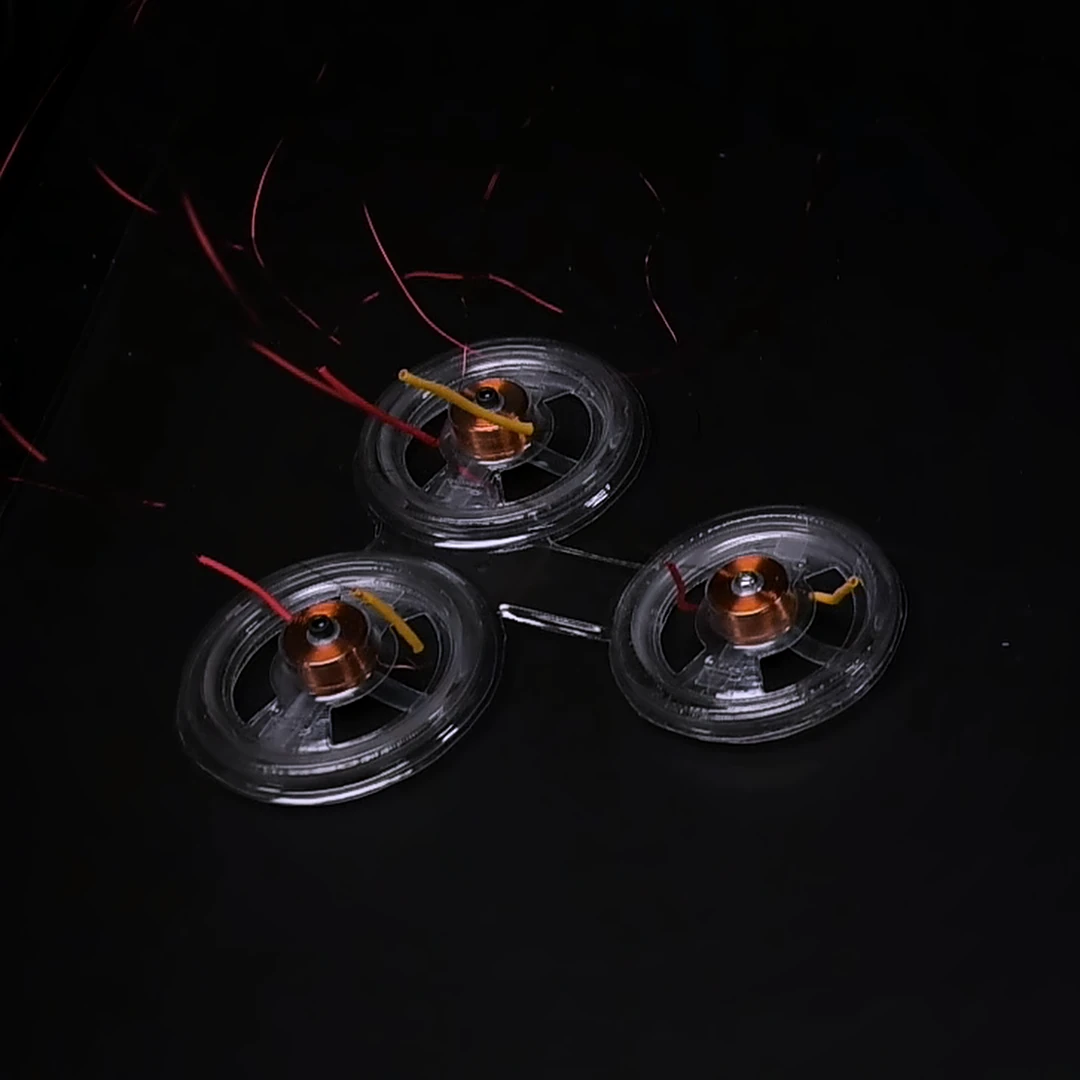
Three BEAMbot modules seen from above during a turning test: clear PETG shells with copper coils at their centers, joined in a triangle and tethered by thin wires, on a black surface. BEAMbot · 3 modules
Fig. 1Three BEAMbot modules during a turning test (video frame): vacuum-formed PETG shells, laser-cut flexures, magnets and copper coils on a wired prototype.

Recent

  1. The three-module BEAMbot now moves forward and turns left or right, depending only on which cells snap. See the video

  2. The VAK Embodied Systems Lab published the BEAMbot project page. View ↗

  3. LeafBreath, a ~$50 leaf-resident photosynthesis sensor I helped design, is now on the lab website. View ↗

  4. Our cellulose-hydrogel actuator paper (I am co-first author) is under major revision at Science Advances.

Research directions

Four threads, one question.

  1. 01

    Mechanical intelligence

    Bistability, snap-through and folding as ways to store state, release energy and sequence motion without continuous power.

  2. 02

    Soft & sustainable actuation

    Fabric composites and biodegradable hydrogels whose material response decides what a soft robot can do, from 10 MPa deep-sea grasping to degradable grippers.

  3. 03

    Fabrication as a design tool

    Vacuum forming, post-form laser cutting and heat bonding used to turn thin shells and coated textiles into programmable mechanisms.

  4. 04

    Human–environment interaction

    Instruments that make living processes perceptible, and machines meant to touch people, plants and ecosystems safely.

01Selected research

From a physical property to a working system.

Each project starts from a snap, a fold or a material trade-off and follows it into a robot or an instrument. For every team project I say what my own part was.

Looping render, 12 seconds: one BEAMbot module separates into its parts, reassembles, and snaps between its two stable states.
Render · exploded view
CurrentVAK Embodied Systems Lab · Northwestern

BEAMbot

Bistable Electromagnetically Actuated Modular robots

How much controllable locomotion can emerge when electronics selects where and when bistable cells snap?

Each cell is a vacuum-formed PETG shell with laser-cut flexures, permanent magnets, a coil and a mechanical stop. Its geometry sets the force response. Bistability stores the state and elastic energy without holding current, and a short pulse triggers the snap. Across modules, the choice of which cells snap and when turns discrete states into whole-body motion. The tethered three-module robot moves forward and turns this way.

Stroke
19.0± 0.6 mm
10-mm shell, 0.3-mm PETG
Set / reset force
0.54/0.27N
mean ± SD, 3 specimens × 3 cycles
Jump clearance
22mm
electrically triggered; 35-mm hub rise
Gaits
3
forward, left and right turns, all from actuation timing

My roleI developed the thermoforming and post-form laser-cutting process for the curved bistable cells. I also worked on magnet–coil switching, built single- and multi-module prototypes and their drive electronics, and ran the mechanical and switching characterization.

Open questions
  • How can shape program mechanics? Calibrated FEA and repeated mechanical tests will link dome shape, flexure pattern and crease condition to the stable states and actuation requirements.
  • How do arrangement and timing compose motion? Placement, orientation, activation order and phase will be varied to find repeatable translation and turning.
  • How can actuation get lighter? Off-center magnets and multilayer flexible-PCB coils will be weighed against switching force, pulse energy, heating and mass, working toward untethered modules.
  • How can modules change capability? Interchangeable mechanical cells and electronic “lids” could allow local control with shared power.

With Paul Ducarme and Lucia Stein-Montalvo · PI: Nivedita Arora · First author Manuscript in preparation
Try it · measured curve

Push a cell over its energy barrier.

Drag the shell or use the slider. Let go before the unstable point and it springs back. Push past it and the cell snaps into its second state, where it stays with no power. The curve is traced from our baseline test (H = 10 mm, t = 0.3 mm PETG).

δ0.0mm
F0.00N
State1

From 7.6 to 12.3 mm the curve is interpolated, because a pushing probe cannot hold the shell there. The shell drawing is schematic, not to scale.

state 1 state 2
InstrumentVAK Embodied Systems Lab · Northwestern

LeafBreath

A ~$50, leaf-resident instrument that makes photosynthesis observable

Research-grade gas-exchange analyzers cost tens of thousands of dollars and need an operator to hold a cuvette on one leaf at a time. LeafBreath instead seals a small thermoformed chamber onto an intact leaf and measures how fast the leaf changes the air inside. Net assimilation and transpiration both come from the CO₂ and humidity slopes. With no pump, scrubbers or gas supply, it can stay on one leaf for days.

Early records run for 5 to 13 days on C3, CAM and facultative-CAM species. A comparison against a research-grade reference instrument is under way.

My roleMechanical design of the transparent, airtight chamber and a low-power lid mechanism. I then asked whether the switch itself could be thermoformed PETG. It could: a magnet-triggered bistable flexure that holds its state without power. That mechanism grew into BEAMbot.

With Qitong Li, Julia Wang, Dayanara Chavez, Raj Dave and Cassandra Marquez · PI: Nivedita Arora · Project page ↗

Four fabrication iterations for the chamber

  1. Resin castingClear, but demolding was unreliable
  2. Direct PETG printingEasy to make, but optically hazy
  3. Vacuum formingThin, clear, light shells from reusable 3D-printed molds; the idea came from food packaging
  4. Post-form laser cuttingReleased flexures on a curved shell give a bistable switch, and led to BEAMbot

Earlier research

Video still of the cellulose-hydrogel pneumatic actuator

Westlake University · 2024–25

Biodegradable cellulose-hydrogel actuators

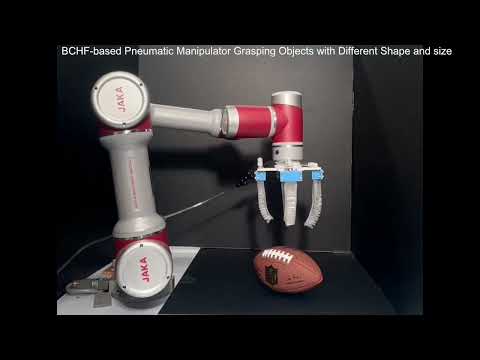
This cellulose film looks like PET, but its mechanics change with crosslinking and regeneration. By tuning how it is prepared, we made pneumatic chambers that deform at low pressure yet stay robust under higher loads, and that can degrade after use.

My roleI designed and prototyped the gripper, modeled its multimodal kinematics, and integrated the mechanics with electrical control for system-level tests.

Co-first authorMajor revision, Science Advances

CAD assembly and physical prototype of a four-finger fabric hydraulic gripper

Westlake University · 2023–24

Fabric hydraulic actuators for the deep sea

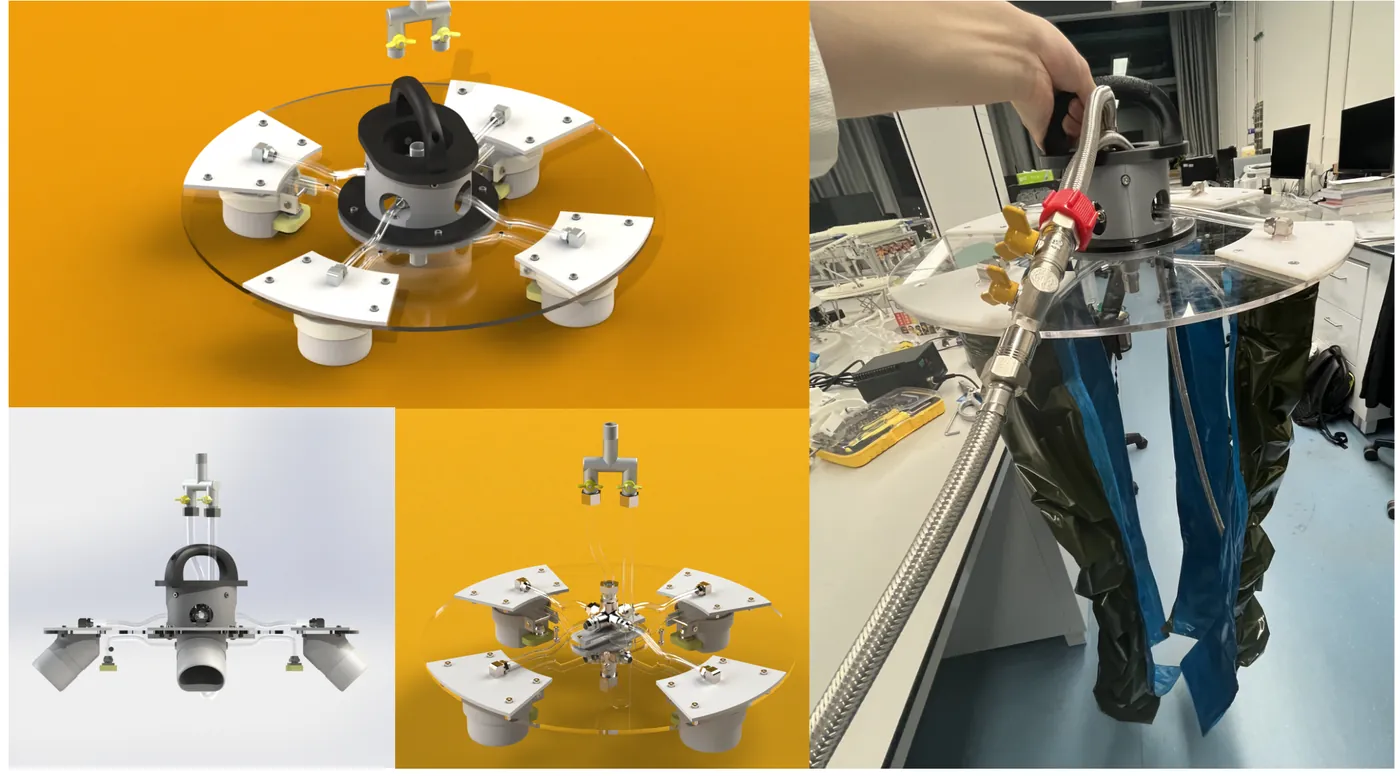
TPU-coated fabric gives up extreme strain in exchange for pressure tolerance and load capacity. The 1.2-m, four-finger arm kept a stable deformation at 10 MPa of simulated hydrostatic pressure while handling heavy objects. A hydraulic winding mechanism let its length adapt from about 0.5 to 1.2 m.

My roleI designed the 1.2-m fabric chamber and reworked how the actuators were fabricated, cutting production time by about a third and improving airtightness. I also designed the hydraulic drive and winding mechanism and ran the underwater and high-pressure grasping tests.

NUS (Suzhou) Research Institute · 2021–22

An origami manipulator that curls like an elephant trunk

A single-degree-of-freedom origami arm. I searched crease parameters for the largest reachable range with kinematics I wrote in MATLAB. The prototype then showed what the model had left out: PLA panels, TPU-coated fabric joints heat-pressed above 180 °C, joint clearance, and motor torque against fatigue.

My roleMy final-year project. I did the kinematics and optimization, the prototype, and the actuation and control electronics.

Video still of a presentation on physics-informed neural networks

Modeling study

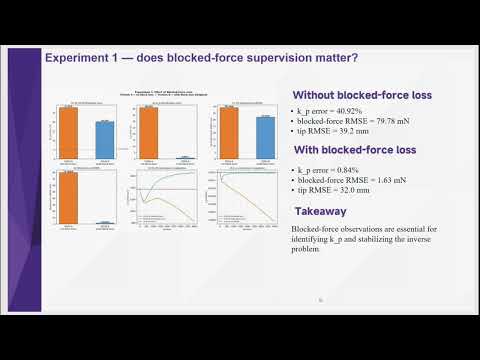
Learning actuator parameters under physical constraints

Physics-informed neural networks for inverse identification of the parameters of a pneumatic soft bending actuator.

Undergraduate projects and coursework
  • Quadruped robot for campus patrolNational College Student Innovation Training Project, Beijing Jiaotong University. Group leader.
  • MEAM 5200 final projectRobot-arm manipulation, University of Pennsylvania
  • Bio-inspired roboticsCoursework on bio-inspired actuators, sensors and computation
  • 36th College Students’ Physics Competition (Beijing region)Provincial-level third prize

02Publications & manuscripts

Work in the record.

Statuses as of September 2026. A dagger (†) marks equal contribution.

  1. Major revisionScience Advances

    Development of a Degradable, High-Toughness, and Flexible Pneumatic Actuator Based on Cellulose Hydrogel and Its Applications

    Pingdong Wei†, Xuanang Chen†, Zhuang Zhang, Hanqing Jiang

    My part: gripper design, prototyping and system-level validation.

  2. In preparationManuscript

    Manuscript on BEAMbot, covering bistable mechanics, electromagnetic switching and modular locomotion

    Xuanang Chen (first author), Paul Ducarme, Lucia Stein-Montalvo; PI: Nivedita Arora. VAK Embodied Systems Lab, Northwestern University

  3. In preparationReview

    Intelligent Origami: From Foldable Structures to Delicate Robots and Devices

    Xuanang Chen, Zhuang Zhang, Pingdong Wei, Hanqing Jiang

    My part: I drafted the manuscript.

03How I work

Design, fabricate, measure, then ask why.

Mechatronics, electrical engineering and mechanics, used together in one loop.

  1. 01

    Design the mechanism

    Let geometry, compliance and stable states do the controller’s work.

    • SolidWorks
    • Inventor
    • MATLAB
  2. 02

    Fabricate to learn

    Fast build loops that expose what idealized models miss.

    • Thermoforming
    • Laser cutting
    • 3D printing
    • TPU bonding
  3. 03

    Actuate & integrate

    Magnet–coil, fluidic drive and embedded electronics sized to the mechanism.

    • PCB design
    • Embedded C
    • FPGA
    • Hydraulics
  4. 04

    Measure & model

    Tests and FEA that separate a real principle from a one-off demo.

    • Mechanical testing
    • Abaqus
    • COMSOL
    • Python

04Background

A non-linear path, taken on purpose.

Mechatronics taught me to integrate, electrical engineering to drive and sense, Westlake that materials decide what a robot can be, and mechanics to reason from first principles. The VAK Lab is where all four meet.

  1. Now

    Visiting Research Scholar

    VAK Embodied Systems Lab, Northwestern University, with Prof. Nivedita Arora

    BEAMbot · LeafBreath

  2. 2025–26

    Northwestern University

    Master’s degree, Theoretical and Applied Mechanics

  3. 2024–25

    Westlake University

    Research Assistant with Prof. Hanqing Jiang

    Cellulose-hydrogel pneumatic actuators and grippers

  4. 2023–24

    Westlake University

    Summer research with Prof. Hanqing Jiang

    Fabric hydraulic actuators for deep-sea grasping

  5. 2022–24

    University of Pennsylvania

    M.S.E., Electrical Engineering

  6. 2021–22

    NUS (Suzhou) Research Institute

    Exchange year and final-year project on origami manipulators

  7. 2018–22

    Beijing Jiaotong University

    B.Eng., Mechatronic Engineering

05Contact

Let’s talk about soft, multistable and interactive machines.

I’m applying to Ph.D. programs for Fall 2027. I’m glad to hear from faculty and students working on mechanical intelligence, soft robotics, digital fabrication and physical interaction.